Flash USDT Explained What is the Best Method and Why
· based on the channel Rca FastPrint
Flash USDT is a technique for creating USDT tokens through smart contract deployment and interaction, primarily on Ethereum or compatible networks. This method leverages tools like ChainIDE, an integrated development environment for blockchain development, and MetaMask, a widely used wallet for managing Ethereum assets and signing transactions. The best Flash USDT method focuses on understanding the ERC20 token structure and following secure development and testing practices to avoid errors or security risks.
Understanding Flash USDT and Its Purpose
Flash USDT refers to a process where users create or simulate USDT tokens by deploying or interacting with smart contracts that replicate USDT’s ERC20 token standard. This method can be used for educational, testing, or development purposes but requires caution to avoid scams or loss. The concept revolves around generating tokens that behave like USDT, often called “flash” because of the rapid token creation via code.
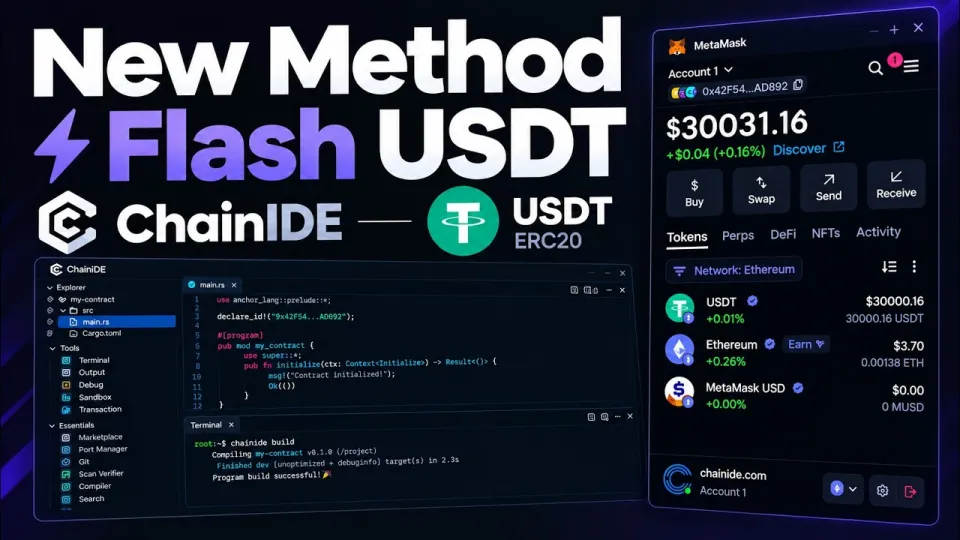
Video: Flash USDT | Found a NEW Method on ChainIDE
ChainIDE Setup for Flash USDT Creation
ChainIDE (https://chainide.com/) is a cloud-based platform that facilitates smart contract coding, compilation, deployment, and testing. For Flash USDT:
- Register or log into ChainIDE.
- Create a new Solidity project.
- Use prepared scripts or write your own ERC20 token contract code adapted for USDT characteristics.
- Compile the contract to check for syntax errors.
- Deploy it to a test network (e.g., Ethereum testnet).
This environment simplifies managing contract lifecycle without local setup.
ERC20 Token Structure Key Points
Flash USDT tokens follow the ERC20 standard, which defines functions and events necessary for token management:
- `totalSupply()`: total token amount
- `balanceOf(address)`: holder’s balance
- `transfer(address, uint256)`: token transfer
- `approve(address, uint256)`: allowance setup
- `transferFrom(address, address, uint256)`: transfer via allowance
Understanding and customizing these functions is critical for emulating USDT behavior. The contract must properly handle decimals (usually 6 for USDT), symbol, and name.
Connecting and Interacting with MetaMask
MetaMask acts as the interface between user and blockchain:
- Install MetaMask extension or app.
- Connect MetaMask to the Ethereum network or testnet used in ChainIDE.
- Link MetaMask to the deployed Flash USDT contract.
- Use MetaMask to sign transactions like token minting or transferring.
This connection ensures users control private keys and confirms transactions securely.
Testing and Verification Steps
Before using any Flash USDT contract with real funds, comprehensive testing is essential:
- Verify the contract source code matches expected logic.
- Test functions like minting, transfers, and approvals on testnets.
- Check for common mistakes such as incorrect decimals or faulty allowance logic.
- Confirm network and contract address accuracy in MetaMask.
Avoid interacting with unknown or unverified contracts on mainnet to prevent scams.
Common Mistakes and How to Avoid Them
Typical errors in Flash USDT creation include:
- Using incorrect contract addresses or networks.
- Skipping code verification which risks malicious code.
- Transacting on mainnet without proper testing.
- Ignoring MetaMask warnings or transaction details.
Always follow best practices for smart contract security and wallet safety.
Useful Links
- ChainIDE official platform for smart contract development: https://chainide.com/
- Flash USDT script and tutorial: https://sites.google.com/view/defiflashusdt
Итог
Flash USDT provides a valuable method for creating and understanding USDT tokens through smart contract development using ChainIDE and MetaMask. Following a clear workflow that includes contract setup, ERC20 token configuration, wallet connection, and rigorous testing ensures a secure and educational experience. For a detailed walkthrough and tips, the channel Rca FastPrint offers an excellent guide. Explore ChainIDE to start your own Flash USDT projects safely and effectively.
Key takeaways
- Flash USDT is a method to create USDT tokens using smart contract deployment on Ethereum or compatible chains
- ChainIDE is an online development environment for Solidity and smart contracts used in Flash USDT creation
- MetaMask is essential for connecting wallets and interacting with smart contracts securely
- The Flash USDT method involves ERC20 token structure and requires careful contract verification
- Testing and verification steps are crucial to avoid common mistakes and risks
Source: Flash USDT | Found a NEW Method on ChainIDE · Markdown version
Questions & answers
What is Flash USDT?
Flash USDT is a method to create or simulate USDT tokens by deploying ERC20 smart contracts, mainly for testing and educational purposes.
What tools are essential for creating Flash USDT?
ChainIDE is used for smart contract development and deployment, while MetaMask is necessary for wallet connection and signing transactions.
Is it safe to use Flash USDT contracts with real funds?
No, you should never send real funds to unknown contracts. Always verify contract code and test thoroughly on testnets before any real interaction.
What are common mistakes when working with Flash USDT?
Common errors include using wrong contract addresses or networks, skipping contract verification, and ignoring wallet transaction details, which can lead to loss or scams.